
“Welfare washing” is a relatively new term, borne from the roots of greenwashing. In a more informed and environmentally conscious world, greenwashing erupted as a successful marketing strategy to reassure users that a product was carbon conscious, earth-friendly or had some form of “green” credentials. Unfortunately, many of these claims can be misleading, spouted to increase sales rather than a passion for protection. Frustratingly, we are now seeing the same thing happening with animal welfare.

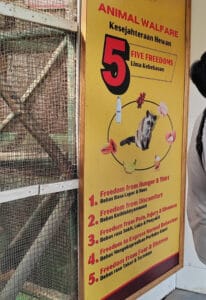
An interpretation board displaying animal welfare “buzzwords” stands in stark contrast to the facility’s clear failure to adhere to or implement these fundamental practices and principles.
A supporter of Wild Welfare recently reached out to us to highlight a distressing situation they had encountered in Indonesia. As part of an organised tour, our supporter accidentally found themselves on a civet coffee farm. The civets were in tiny, cramped and barren cages with nowhere to go and little else to eat besides endless coffee cherries. Stereotypic behaviours such as frantic pacing indicated their distress levels, frustration at their restrictive environment, and the problematic ways in which they were managed. Sadly, these animals are often caught from the wild using cruel and traumatic methods.
Aside from the obvious exploitation and suffering that was witnessed during this visit, something that stood out to our supporter was a prominent yellow poster on the wall, written in a mix of Bahasa Indonesia and English, explaining the five freedoms. The five freedoms are a now slightly outdated model of animal welfare, highlighting the importance of the reduction of negative welfare states such as hunger and pain. The fact that this information was displayed so prominently in the civet farm showed an acknowledgement and awareness of the concept, but the surrounding reality showed little to no evidence of using this welfare model to direct the way the civets were managed.
However, anyone on this tour without the behavioural knowledge of the species might feel reassured by the presence of this poster. If the facility is actively mentioning animal welfare concepts, then surely they must be abiding by those governing principles? Sadly we know this is not the case.
THIS IS WELFARE WASHING
There are many other examples of this, particularly within the tourism industry, such as a facility named as an animal sanctuary while the reality still exemplifies exploitation. Another facility might make use of buzzwords like “enrichment” or “positive reinforcement training” whilst evidence of the use of these management techniques is severely lacking.
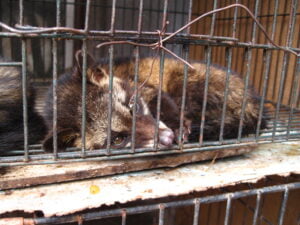
©The Civet Project
Welfare washing feels like the next hurdle to tackle when it comes to encouraging ethical tourism decisions, and frustratingly, the goal posts keep on moving. It isn’t enough to see a statement of animal welfare; we need to be searching for evidence to back up that claim. The more we ask for that evidence whenever we are planning any touristic activity involving animals, the more we can push forward animal welfare standards to something more acceptable. As an example, this could be checking that a sanctuary you visit is GFAS accredited, or calling out a tour guide who chooses to take you closer to a whale or dolphin than allowed by the compliance standards which govern the experience.
Our understanding of how to meet animal’s welfare needs, and the sentient capabilities of animals has progressed, and organisations or facilities which house animals now need to make drastic changes along with this understanding. We also need to be aware of what the next hurdles will be in the challenge of this, and how we can tackle them to prioritise true and sustainable animal welfare improvements.
There are no industry guidelines or standards, and enforcement of the current legislation is limited, leading to exaggerated claims of care and welfare by unscrupulous civet coffee farmers. The civets on display at a touristic facility may just be the tip of the iceberg, with a handful living in better conditions and in fewer numbers for the visiting public. The reality is that there will be many more in severely limiting conditions producing the coffee to supply the domestic and international markets.
Going back to the Indonesian facility, another poster which was displayed and actively spoken about by the tour guide, showed the alleged dietary variation over the course of a week for the civets. The poster claimed they are only fed coffee cherries twice a week, with other foods included in the diet for the majority of each week. Our supporter did see evidence of other items being fed at this facility, but unfortunately, the high demand for civet coffee means that many farms resort to a singular diet to meet the consumer’s thirst for the product. Such restrictions in diet are also thought to lead to early deaths of civets, and are illegal under Indonesian law. The question of whether milk is a healthy option for species which may be lactose intolerant also remains to be answered.
Welfare washing is a worrying trend, spreading disinformation like a disease. However, we can inoculate ourselves by seeking out the most reliable information from scientific communities utilising evidence-based sources.
We can also:
• Seek out information before booking on welfare policies (remember these are different to sustainability policies). Ask for evidence where possible.
• Book with companies which are governed by an accreditation body where possible.
• Leave reviews on sites like TripAdvisor calling out welfare washing or unethical practices.
Visit our Animal Welfare Tourism pages and Animal Welfare Resources for more.
For more about Civet Coffee farming, visit TheCivetProject.com






Discussion about this post