
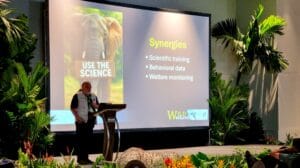
Global animal welfare organisation, Wild Welfare, recently took centre stage at the 33rd South East Asian Zoos and Aquariums Association (SEAZA) Conference in Singapore to help drive a decisive shift toward improved animal welfare across the region. Hosted by Mandai Wildlife Group, the event provided a platform for the animal welfare charity to explore and share how their experts are working to embed ethical decision-making and welfare-driven strategies into the future operations of member facilities.
Wild Welfare co-founder and Field Operations Director, Dave Morgan, presented, Exploring the Role of Empathy in Animal Welfare‘, a thought-provoking address on the intersection of emotion and evidence-based practices in captive animal care.
 Dave guided the over 400 delegates from 27 countries through the complexities animal caregivers face when balancing emotional commitment with the need for following structured scientific rigour. He explored how both cognitive and emotional empathy are vital for individualised animal care, highlighting their important role in significantly enhancing animal welfare through ethical practices. Drawing on compelling research the presentation advocated for the integration of empathy with established, evidence-based practices, with the aim of avoiding issues related to anthropomorphisation or caregiver fatigue. “The human perspective is a non-negotiable component of good welfare practice”, expressed Mr Morgan. “Empathy, though not sufficient on its own, is essential when combined with structured, evidence-based practices and training to achieve the best outcomes for captive animals.” Dave concluded.
Following the main conference, the Wild Welfare team shifted focus to presenting an intensive, full-day workshop about ‘Advancing Animal Welfare through Strategic Institutional Species Planning’. This targeted event was attended by twenty participants including veterinarians, and senior management from across SEAZA’s membership and associated institutions.
Building upon SEAZA’s recent significant milestone of implementing a WAZA approved animal welfare accreditation process, the workshop focused on the next crucial steps of integrating welfare and ethical considerations directly into the fabric of institutional planning. The core objective was to move facilities beyond simple collection management and to begin developing a comprehensive Institutional Species Plan (ISP) that defines the roles, objectives, and welfare goals for every species chosen to be housed at that respective zoo or aquarium.
 The workshop engaged participants in collaborative, problem-based learning exercises, exploring the benefits of a welfare centric ISP. “A well crafted ISP has the power to improve conservation outcomes, reducing surplus animals, and allowing for better resource planning, all while acknowledging common challenges such as staff time and reduced acquisition flexibility.” explained Dr. Lisa Yon, Associate Professor in Zoo and Wildlife Medicine at the University of Nottingham.
Dr Yon was present to share the six different types of ethical frameworks, including virtue, utilitarianism, and deontology; detailing how each can be used to aid the process of planning. Participants had the opportunity to apply this knowledge in a scenario-based exercise whereby groups debated a case and justified their decisions, using one of the frameworks. This process allowed each participant to deeply appreciate how different ethical standpoints offer unique insights into the necessity of underpinning all planning with ethical and welfare considerations.
Feedback received from pre and post-workshop surveys demonstrated a clear impact, with 80% of participants reporting an improved understanding of ISP development, and a significant 60-70% reporting a major increase in their understanding of the importance of welfare and ethics within the planning process. “Embedding welfare into strategic planning is a positive, proactive step that supports the mission of zoos and aquariums, helping them to elevate animal care standards and start to meet the welfare needs of the animals in their care.” explained Wild Welfare Director, Simon Marsh.
Wild Welfare’s role at the conference extended beyond their own talks and workshops, with both Directors actively attending various other presentations and workshops. They each offered valuable thoughts and feedback to further assist SEAZA and their members with prioritising welfare across all elements of their operations.
 Collaborative discussions with the SEAZA Animal Welfare and Ethics Committee (AWEC) cemented plans for a continued partnership with Wild Welfare into 2026 and beyond. Wild Welfare will also continue to support the vital auditor Continuing Professional Development (CPD) training programme, shadowing auditors in live SEAZA accreditation audits, ensuring consistency and reliability across the board. Plans were also put into motion for a co-hosted workshop to review and update the SEAZA Animal Welfare Standard and its supporting documents, aimed at driving up animal care and welfare standards across all member zoos and aquariums. Crucially, this collaboration will include “accreditation self-assessment training” for facility members, equipping staff with the tools necessary for them to conduct thorough internal audits using the SEAZA standard every year between official accreditation visits. This initiative aims to further improve positive animal welfare outcomes across the region.
“We would like to thank Mandai Wildlife Group for supporting Wild Welfare, allowing us to continue our collaboration with SEAZA and delivering presentations and workshops that continue to embed animal welfare into the policies and practices of zoos and aquariums across SE Asia. Building capacity and training for change is at the core of what we do at Wild Welfare, so animals can begin to thrive under human care, not just survive” added Simon.
Wild Welfare continues to champion the principle that zoo animal welfare should never be an afterthought, but an essential foundation that all modern zoological facilities must prioritise.
ENDS
Wild Welfare is devoted to improving the welfare of captive animals across the world. You can support our efforts by sharing this article, signing up to our newsletter, following our social media accounts (Facebook and Instagram), or by making an online donation. Every small contribution can help us to develop our vital accessible animal resources. Thank you.
Notes to Editors
For more information or interview requests please contact Wild Welfare on communications@wildwelfare.org
Wild Welfare is a global organisation committed to improving animal welfare for captive wild animals. By uniting the world’s leading zoos, zoo associations and animal welfare organisations, we build trusting partnerships that help provide long-term solutions to critical wild animal welfare issues.
Our vision is to end the suffering of captive wild animals around the world and ensure full and sustainable protection is given to all animals in human care. Find out more at wildwelfare.org. Registered charity in England (no.1165941).






Discussion about this post