
A shocking scientific report exposing acute and systemic welfare failures within Japan’s Exotic Animal Cafes has today been released by international animal welfare organisation Wild Welfare. The study, supported by Animal Welfare Japan and conducted in collaboration with Nippon Life Sciences University (Japan) and Nottingham Trent University (UK) assessed the welfare of animals in almost 80 cafes across major Japanese cities. The report revealed that animal welfare was consistently low across all taxa and that a significant proportion of these establishments are operating far below even basic animal welfare standards.

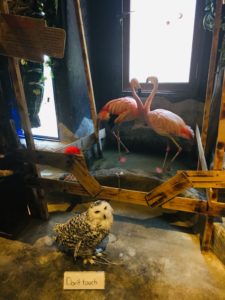
An exotic animal cafe in Japan housing flamingos and owls in cramped unsuitable spaces.
The report highlights a severe lack of consideration for the suitability of environments for a range of animals including owls, snakes, otters and hedgehogs. Captive wild animals are denied adequate space, and any freedom of choice, critically limiting their ability to exhibit any natural behaviors. In addition, many of the human-animal interactions offered, such as holding or petting a wild animal in these cafe environments, poses a multitude of risks to both animals and humans.
Following one such cafe visit, Wild Welfare Senior Advisor, Georgina Groves noted how “Exotic animal cafés may appear novel or even educational, but behind this trend lies a profound welfare concern. Species such as birds, reptiles and all other wild animals, have highly specialised behavioural and environmental needs that simply cannot be met in these confined spaces or through repeated handling. Animals are not props for human amusement, they are complex, sentient beings whose welfare depends on freedom of choice, natural behaviours, and environments far removed from café settings.” Georgina explained.
In particular, the report emphasises a failure within Japan’s system of regulation. Exotic animal cafes are currently licensed similarly to zoos and aquariums. However, welfare standard requirements and current oversight of such licensed facilities related to animal cafes is insufficient and extremely poor, resulting in significant welfare gaps.

Capybara housed in unnatural cramped animal café forced to interact with guests.
To encourage immediate actions, Wild Welfare along with a coalition of NGOs, academics, and veterinary experts have submitted a joint statement to Japanese policy makers, requesting their commitment to urgently support four key pledges. The four pledges include providing a comprehensive review of existing exotic cafés, urgently implementing measures to mitigate zoonotic disease risk, support the restriction of ownership for certain wild species, and agreeing to phasing out exotic animals in cafes by ending the breeding of new animal stock.
“There is a clear and growing appetite within Japan, across international NGOs, scientists, and animal facilities, to implement improved animal welfare standards through stronger legislation” explained Simon Marsh, Director of Wild Welfare. “Our mission is to allow all captive wild animals the opportunity to have ‘voices’ heard, their needs met, and the ability to live a good life worth living” Simon concluded.

An otter restlessly circles a tiny tray of water inside an exotic animal café.
The peer-reviewed paper serves as a wake-up call for the government to address the urgent need for wild animal welfare reform. As public understanding, expectations and scientific understanding continues to advance, out-dated practices often seen at these establishments must continue to be challenged and updated accordingly. Wild Welfare remains committed to advocating for meaningful change within the exotic animal cafe industry, to ensure all animals receive the care and better living conditions they desperately deserve.
To travel responsibly and ensure your trip doesn’t unknowingly contribute to animal suffering, access Wild Welfare’s free guide to animal-friendly tourism at https://wildwelfare.org/animal-friendly-tourism/.
ENDS
Wild Welfare is devoted to improving the welfare of captive animals across the world. You can support our efforts by sharing this article, signing up to our newsletter, following our social media accounts (Facebook and Instagram), or by making an online donation. Every small contribution can help us to develop our vital accessible animal resources. Thank you.
Notes to Editors
For more information or interview requests please contact Wild Welfare on communications@wildwelfare.org
Wild Welfare is a global organisation committed to improving animal welfare for captive wild animals. By uniting the world’s leading zoos, zoo associations and animal welfare organisations, we build trusting partnerships that help provide long-term solutions to critical wild animal welfare issues.
Our vision is to end the suffering of captive wild animals around the world and ensure full and sustainable protection is given to all animals in human care. Find out more at wildwelfare.org. Registered charity in England (no.1165941).







Discussion about this post