
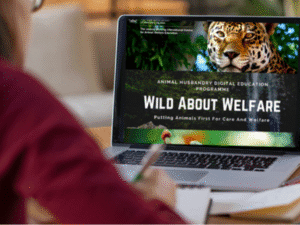
carecareThe quality of life for a captive wild animal is strongly linked to the knowledge and experience of their human caregiver. However, around the world, opportunities for professional training and personal development can be limited. In 2021, global charity Wild Welfare set out to bridge this gap by launching ‘Wild About Welfare’, a completely free-to-use Digital Education Programme that has grown from an ambitious idea into a truly global resource. Over the past five years, the course has up-skilled animal care staff across 70 countries, driving measurable improvements for potentially thousands of captive wild animals.
On International Day of Education, Wild Welfare published a powerful new impact report, ‘Wild About Welfare: Five Years On’, showcasing how this online course is transforming the lives of captive wild animals around the world. The report explores the full scope of the programme’s growth and its future objectives.
 The online programme was initially born out of a pressing need to support animal care staff who do not necessarily have access to formal education or language-appropriate animal welfare learning resources. While the science of animal welfare has advanced over recent decades, access to this knowledge remains minimal for many. For dedicated wild animal caregivers in non-English speaking regions, this represents a significant barrier to improving care and welfare standards. Wild Welfare teamed up with the University of Edinburgh’s Animal Welfare Centre to develop a digital solution that is scientifically robust, practically applicable, and easy to access.
“Studies have observed that the vast majority of wild animal welfare literature (87%) is published in English, making continued professional development inaccessible for many caregivers in zoos, aquariums, sanctuaries, and rescue centres around the world,” explains Sarah Bonser-Blake, Wild Welfare’s Animal Welfare Field Manager. Sarah, who leads development of the e-learning programme, adds: “We wanted to tackle the lack of affordable, practical-focused resources while up-skilling staff with the confidence they require to ensure animals in their care have opportunities to truly thrive.”

Excerpt from the “Five Years On” report.
By combining Wild Welfare’s on-the-ground expertise with the University’s established approaches to digital pedagogy and delivery of digital education, the team created eight core modules covering essential topics ranging from animal behaviour to nutrition and enrichment. These modules blend welfare science with hands-on guidance for daily husbandry, ensuring carers understand both the “how” and the “why” of good animal care. To date, the programme’s key milestones include:
- Over 33,000 user downloads across more than 70 countries.
- 5 translations including Japanese, Vietnamese, Bahasa Indonesia, Thai, and Hindi.
- 45% of a sample of participants have already reported implementing tangible improvements, such as enhanced environmental enrichment and modified feeding routines.
- Since 2022, the digital course has supported in-person blended learning workshops, reaching almost 100 zoo staff members across Southeast Asia and the Middle East.
The real-world impact of this popular online tool is best described by the users themselves. One course participant from Pakistan explained how, “It helped me in understanding the enrichment of species like lions and bears. As a result, boulders and platforms have now been installed in the enclosures to help improve their welfare.”
Dr Louise Connelly, Senior Lecturer at the University of Edinburgh, highlights the importance of this strong partnership: “The Animal Welfare Centre is delighted to have collaborated with Wild Welfare on this e-learning programme. It is contributing to real-world impact for animals and those who care for them. We look forward to further developments and wider outreach over the coming years.”
Looking ahead, Wild Welfare’s vision is even more ambitious, with an aim to reach 60,000 downloads and additional language translations by 2030, creating a future where more captive wild animals can be cared for by skilled, compassionate, and confident professionals.
ENDS
About Wild Welfare:
Wild Welfare is a global charity dedicated to ending the suffering of captive wild animals. They provide expert, practical, and sustainable solutions to improve animal welfare standards worldwide.
About The Animal Welfare Centre:
The Animal Welfare Centre based at the Royal (Dick) School of Veterinary Studies, University of Edinburgh (The Centre incorporates the Jeanne Marchig International Centre for Animal Welfare Education) works to improve the lives of animals through global education, research, and outreach.
Wild Welfare is devoted to improving the welfare of captive animals across the world. You can support our efforts by sharing this article, signing up to our newsletter, following our social media accounts (Facebook and Instagram), or by making an online donation. Every small contribution can help us to develop our vital accessible animal resources. Thank you.
Notes to Editors
For more information or interview requests please contact Wild Welfare on communications@wildwelfare.org
Wild Welfare is a global organisation committed to improving animal welfare for captive wild animals. By uniting the world’s leading zoos, zoo associations and animal welfare organisations, we build trusting partnerships that help provide long-term solutions to critical wild animal welfare issues.
Our vision is to end the suffering of captive wild animals around the world and ensure full and sustainable protection is given to all animals in human care. Find out more at wildwelfare.org. Registered charity in England (no.1165941).






Discussion about this post