
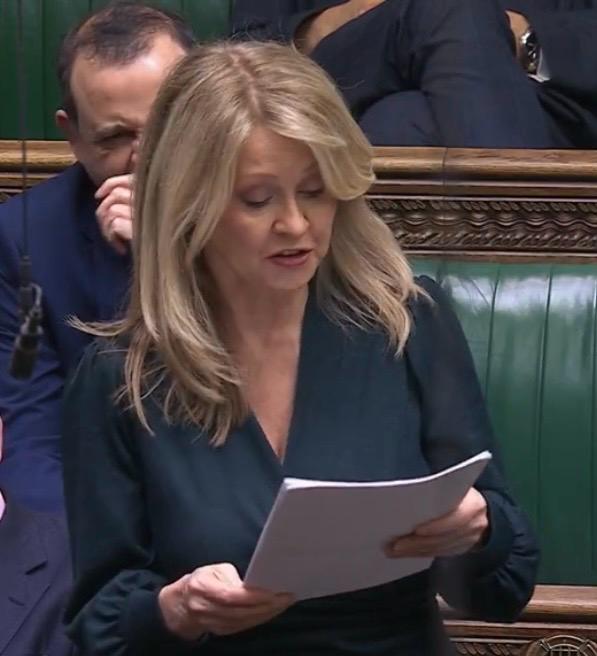
This week, Parliament took a significant step in the long-overdue discussion on mandatory labelling, consumer transparency and legislative oversight when Tatton MP Esther McVey secured leave to introduce a Ten Minute Rule Bill requiring compulsory labelling of halal and kosher meat products.
The Food Labelling (halal and kosher Meat) Bill does not seek to ban halal or kosher meat. Rather, it confronts a democratic deficit that has persisted for too long: the absence of clear, consistent labelling about how animals have been slaughtered before the meat enters the marketplace.

At present, UK animal welfare law requires animals to be stunned before slaughter to minimise suffering. Exemptions, however, permit slaughter without stunning to accommodate certain religious requirements. Under current arrangements, the requirement that meat produced under these religious exemptions be intended solely for Jewish or Muslim communities is not effectively enforced. As a result, a significant proportion of non-stunned meat enters the wider food supply – often without clear labelling at point of sale.
During her speech in the House of Commons, Esther McVey highlighted that the UK now processes hundreds of millions of animals annually using non-stun methods, and in many cases this meat is indistinguishable on the label from stunned slaughtered products. Consumers have no reliable way of knowing whether the meat they purchase involved stunning prior to slaughter. This undermines both freedom of choice.
The bill’s sponsors reflect a cross-section of MPs: Sir Roger Gale, Alberto Costa, Dame Karen Bradley, Sir Edward Leigh, Graham Stringer, Rupert Lowe, Sammy Wilson, Jim Allister, Lee Anderson and Sarah Pochin were recorded as the Members presenting the bill. By aligning behind this measure, these parliamentarians acknowledge a fundamental principle: transparency in food production is a legitimate public interest in its own right.
Critically, information about slaughter methods matters to ordinary consumers who expect honesty from food labelling. Official statistics cited during the debate show how large the gap has grown between legal expectations and industry practice, with non-stunned slaughter increasingly prevalent across some sectors. Without clear labelling, supermarkets and food outlets are free to sell cheaper non-stunned meat without disclosing the method of slaughter simply because the law does not compel transparency.
For animal welfare campaigners, mandatory labelling can serve as a foundation for informed choice, helping consumers to align purchases with their choices. It also exposes regulatory loopholes that allow exemptions originally intended to meet specific religious needs to become, in practice, broader commercial privileges.
Some commentators have already challenged aspects of the debate, noting that halal and kosher certification systems already label products for religious consumers. Yet this observation misses the wider legislative point: existing certification serves religious communities by indicating suitability according to religious law, but it does not, in many cases, indicate whether the animal was stunned prior to slaughter – a detail that is often material to consumer choice in secular contexts as well as religious ones.
The Ten Minute Rule procedure serves an important parliamentary purpose: it brings issues that are not otherwise the subject of government time into the spotlight. By advancing this measure, Ms McVey and her sponsors ensure that both the Government and the public must confront uncomfortable truths about the lack of mandatory labelling. In the weeks and months ahead, this bill will generate debate not just about labelling but about how exemptions to welfare law are applied.
Mandatory labelling of slaughter methods would bring increased transparency and, importantly, greater accountability for the everyday choices made by the British public at the supermarket checkout.
Bill Transcript
That leave be given to bring in a Bill to introduce compulsory labelling of halal and kosher meat and products containing halal and kosher meat; and for connected purposes.
This is a Bill about animal welfare, transparency in meat production and consumer choice. It does not seek to ban halal or kosher meat. It seeks to ensure that it is clearly labelled. It is important that consumers have such information so that they can make an informed choice about what they are buying. Currently, consumers do not have that information, and many are purchasing and consuming halal and kosher meat without their knowledge and agreement.
The unique process of halal and kosher meat requires the animal to have its throat slit. In the case of halal meat, the animal is often stunned before it is killed—although it might not be—and for the shechita killing for kosher meat, there is no pre-stunning. This lack of stunning causes the animal to experience severe pain. An individual concerned about animal welfare would want to know if the animal has been stunned prior to slaughter. Likewise, there are many religious groups who want to know what they are consuming, too and whether the meat has been blessed by another religion. In all those cases, clear labelling is essential to make an informed choice.
Currently, the legislation that regulates animal slaughter is set out in assimilated EU regulation 1099/2009 on the protection of animals at the time of killing, as well as in the Welfare of Animals at the Time of Killing (England) Regulations 2015. Under these laws, animals must be stunned before they are killed, but exemptions exist for killing without stunning in accordance with specific religious rites. Added to that, there are currently no requirements for such meat to be labelled.
What was once an exemption to the accepted stunning process of animals has become a growing part of the UK’s meat market. The Government’s own figures show that of the 1.035 billion animals processed in English and Welsh slaughterhouses in 2024, an estimated 214.6 million were slaughtered to produce halal meat. The analysis shows that the proportion of meat supplied by non-stun slaughter is about four times greater than the proportion of Muslims and Jews in the UK. Although Government guidance is clear that meat that results from non-stun slaughter “must be intended for consumption by Jews or Muslims”, production is clearly going way beyond that, so much so that the UK now exports halal meat. Between 2018 and 2019, there was an almost 700% increase in the volume of sheep meat exported to the United Arab Emirates, all of which is required to be halal.
Clearly, without compulsory labelling of non-stunned meat, slaughterhouses have gone down the route of producing more of it. In effect, a two-tier system has been created, whereby some slaughterhouses comply with stunning laws and others do not, citing the religious exemption, though without ever intending to focus their sale on that market. Unfortunately, a driver of the market for non-stunned meat is the fact that a step of the process is removed, meaning that production of non-stunned meat is cheaper. Supermarkets and food outlets can purchase that cheaper meat without ever declaring it to the customer, which is not what was intended by the legislation. We have seen many examples of this over the last 15 years; Britain’s biggest retailers—such as Sainsbury’s, Tesco, Marks & Spencer and Asda—have sold halal or kosher meat without informing the consumer, as have Domino’s, Pizza Hut and KFC. Non-stunned produce is being used by 17 local councils in schools, the majority of which are not Islamic faith schools, without parents or children having the first idea about it. It is also being served in hospitals and local councils.
In December, Labour put forward its much-vaunted animal welfare strategy, a document lauded for its aim of “preventing animals suffering unnecessarily”, which included the banning of boiling live lobsters, banning the use of carbon dioxide to stun pigs, and steps to ensure the more humane slaughter of farmed fish. I was surprised and alarmed to see no mention of the more humane slaughter of animals and the labelling of halal and kosher meat. There was a clear opportunity to call for the labelling of halal and kosher meat, but it was missed. Nowhere in Labour’s 12,500-word animal welfare strategy was it mentioned. We often hear in the House that the UK holds the status of a world leader in animal welfare, but such a glaring gap shows that this country can no longer make such a claim.
Food and You 2, which is a biannual official statistic survey commissioned by the Food Standards Agency, found that the most common spontaneously expressed food concern in 2024 was “food production method”. In August 2022, almost 99% of respondents to the Government’s call for evidence on labelling for animal welfare said that method-of-slaughter labelling should be introduced. In research from the Agriculture and Horticulture Development Board, 92% of halal consumers state that clear halal certification is important, so is it not time we updated our regulations and demanded that our meat was clearly and fully labelled, so that we know what we are buying and eating? Surely that is what consumer choice is all about, and I would wager that the overwhelming majority of animal lovers in the UK expect the House of Commons to support this Bill today.
This Bill will give all consumers assurance that they know how their meat was produced. I urge all Members of the House to support this measure.
Question put and agreed to.
Ordered,
That Esther McVey, Sir Roger Gale, Alberto Costa, Dame Karen Bradley, Sir Edward Leigh, Graham Stringer, Rupert Lowe, Sammy Wilson, Jim Allister, Lee Anderson and Sarah Pochin present the Bill.
Esther McVey accordingly presented the Bill.







Discussion about this post